The plane to Riga, the capital of Latvia, was never as full as it was on Sunday, when the Beitar global leadership delegation left for the place where a hundred years ago the foundations of the movement were laid by Zeev Jabotinsky.
In the alleys of the city, Zev Jabotinsky walked, on his way to meet the high school students who formed the nucleus of Beitar (Brit Yosef Trumpeldor), and came up with the idea of establishing an independent Jewish state, which would not only be founded on the sword but also be a light to the Gentiles. One that would serve as a true home for every Jew wherever he is, and will be a source of values, economic and ideology.
Jabotinsky knew that one should not only talk about a state as expressed in Benjamin Ze'ev Herzl's vision, but also work tirelessly to achieve it. "Beitar's role is completely simple," he wrote, "and yet very difficult: to create the same Jewish type that the people need in order to establish the Jewish state more quickly and in a more perfect manner." He understood that it would not be easy to harness for the purpose and motivate the exiled Jew, the adults, who are troubled by the burden of livelihood and daily life, and made a strategic decision, which influenced the Zionist enterprise, to cast his love on the youth, on the future generation.
Indeed, there was no movement that produced more leaders than the global Beitar movement and its affiliates, the Etzel and Lahi undergrounds. Menachem Begin, Yitzhak Shamir and Benjamin Netanyahu are just some of the Israeli prime ministers who grew up in the beds of the movement during its hundred years of existence.
The delegation of the Beitar organization, which went for the first time to the country where some of the movement's sources of inspiration lie, did not include ministers and members of the Knesset, no luxury meals were served during the visit, and no flashy events were held. in his heritage but maintains his modesty and values.
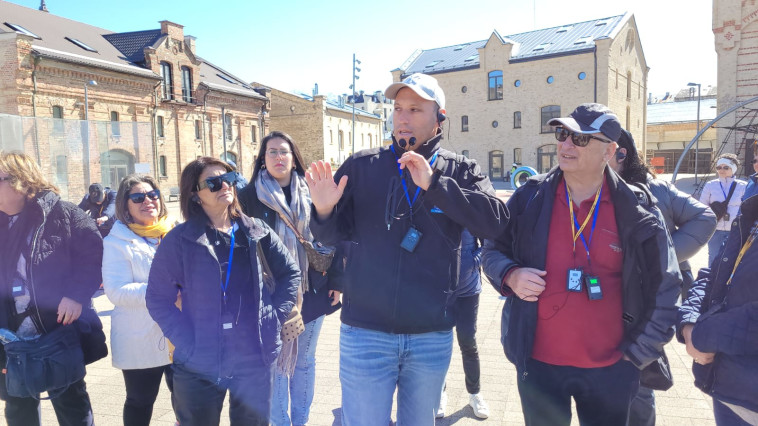 Riga, Latvia (Photo: Matan Wasserman)
There was great symbolism in this journey: setting off immediately after Independence Day, for example, with a body that unites the supporters of the legal reform and its opponents. There are symbols that can still unite many parts of the Israeli people. The participants seem to feel pride in being Betarim.
From 1944 and for years the members of the movement were denounced and forced to go underground. Before the establishment of the state, the movement was on the verge of extinction and was not legitimized by the official Zionist institutions. The transformation of Begin, who was the leader of the movement in Eastern Europe, into the prime minister of Israel in 1977 placed Betar at the forefront. Jabotinsky did not get to see it, but his teaching is still enshrined in the idea of the national camp.
Five days and tears
The person who led the journey is Yigal Brand, the CEO of the global leadership of the Beitar movement, who in the last two years has been leading the Beitar movement to a major change. Brand, 42, is a resident of Havat Yair in Samaria and serves as a major in a special reserve unit. He is a man Impressive, who understands the weight of the responsibility that fell on him when he was chosen to lead this historic movement.
In the past, Brand served as the head of the Zionist Council in Israel and as the head of the staff of the Minister of Culture and Sports Miri Regev. He was recently elected head of the Hebrew language department at the World Zionist Organization, at the same time as his position as CEO of the global Beitar. According to him, there is a direct connection between the two roles.
"Zev Jabotinsky saw the written word as a supreme value," he says. "He understood that words have power and that words not only help in everyday life but also build a real reality. Today, some look longingly at Jabotinsky's legacy and teachings, but many forget Because he and his successors were over the years assigned out of disgust. The same Hadar Beitari who became a consensus in Israeli society, over the years suffered severe blows. Today, everyone wants to be a part of that greatness and uses this concept as a scapegoat to attack the right-wing governments. Jabotinsky proved that his love for the country along with the preservation of the eternal values of the people of Israel are the ones that will create an iron wall against all the enemies that have grown and will grow to the Jewish settlement."
The journey from Betar to Riga lasted for five days. It started with a tour of the old city of Riga, continued to the exhibition and ended at the Pitaba Synagogue in the old city and the Great Synagogue on Gogula Street, where a moving ceremony was held in memory of the hundreds of Jews who were burned alive by the Nazis in 1941, a time Shortly after capturing the city, wrapped in Israeli flags, with tears in their eyes, the participants stood with great excitement and pride, and with the feeling that they are a continuation of Jabotinsky's vision.
The second day of the trip was dedicated to the Beitar Museum, where historical documents discovered inside a large metal suitcase, recently discovered by two soldiers discharged from the Latvian army, in one of the country's forests, were revealed for the first time. Large Beitar flags, various Judaica objects, lamps, menorahs were found there. And also a newspaper clipping bearing the date June 14, 1940, the day of the occupation of Latvia by the Russians.
Later on in the journey, its participants arrived at the museum of the Jewish community, and were present at an official state ceremony at the Rumbala memorial site. During a week between the end of November and the beginning of December 1941, about 25 thousand Jews, most of them residents of the Riga ghetto, were murdered in the Rumbla forest near Riga, and some were buried while alive. It was one of the largest massacres carried out by the Nazis, next to the Babi Yar massacre in Kiev. The singing of the Beitar national anthem and "Hatikva" produced the silent silence that prevailed in the place, and the tears could not be stopped.
Later, the participants arrived in Lithuania and its capital Vilnius, where they toured the Jewish ghetto and the old city and visited the grave of the genius from Vilnius. And finally, the main event to mark the centenary of Beitar was held, in which the Israeli ambassador to Latvia Sharon Rapaport Pelagi, the member of the Latvian parliament and the chairman of the Israel-Latvia Friendship Association Colonel Igors Rives and the businessmen Dan and Itzik Rubenniku, who accompanied the delegation and work hard for the Jewish community in the city, took part. Jacob Haguel, chairman of the World Zionist Organization, sent a video greeting.
 Riga, Latvia (Photo: Matan Wasserman)
"The Embassy of Israel is happy to take part in the event," Rapaport Pelagi said, "this reflects the historical connection between the countries and the contribution of the Jewish community in Latvia to the State of Israel."
Not just football
Riga is a sleepy city, which does not attract many tourists from Israel, despite the charm of its streets and its relative proximity to Israel. For a year and a half it has been going on in the shadow of the war between Ukraine and Russia, hoping that it will not fall victim to the hands of Vladimir Putin.
The residents of the city, who make sure to hang the blue and yellow flags of Ukraine, tell us about the Russian saying, "To conquer a distant goal, one must first pass through the Baltic states." When the war began, a one-year mandatory military conscription was introduced for men over the age of 18. They train and maintain fitness, out of a desire to create a significant force that will withstand attacks against the state. National flags fly over many of the public buildings and institutions as well as on the private homes of the residents, enveloping the city with a strong sense of nationalism.
"The Beitar movement's journey to Riga is a journey that shows where it all began, but in practice it also marks our goal going forward – the future," said Manny Assig, creator of the "80s Show" series and network anchor, who was part of the delegation. "The place where Jabotinsky began to fight ideologically for the people of Israel serves us today as a great dream that has come true."
"Our main goal is that Beitar will not be identified only with the Jerusalem football team and Jabotinsky will no longer be the name of a street," said former MK Nava Boker. "By the 120th year of the global Beitar movement, every boy and girl in Israel deserves Get to know this important movement. In the 100th campaign of the Beitar movement, these seeds were sown."
Michal Aharoni Regev, daughter of Yaakov Sika Aharoni, one of the leaders of the Etzal, who passed away last year, says that "it was an exciting journey, where I saw the special connection that existed between Ze'ev Jabotinsky and the State of Israel before it was founded. Jabotinsky is the high priest of the revival Zionism in the Land of Israel. I have no doubt that now it remains not only to pass on its values and heritage to future generations, but also to act again and again so that the entire public, wherever it may be, recognizes this."
She was also joined by Eli Etzion, publisher of newspapers published in the religious-national sector and chairman of the Elitzur Sports Center, who said that "the journeys of Jabotinsky's life greatly influenced the daily life of the people living in Zion. I have no doubt that this journey is a first step towards connecting and strengthening the parts between the people of Israel and the State of Israel."
"Zev Jabotinsky, the founder of the Beitar leadership and the creator of the National Camp, founded in Riga the most important Zionist revolution in the last hundred years," Brand said. "We are proud to have led a delegation here that traces his legacy in the place where it all began. The Beitar movement, which was founded by Jabotinsky, serves, then and now, as a beacon for the entire Zionist enterprise, whatever it is."
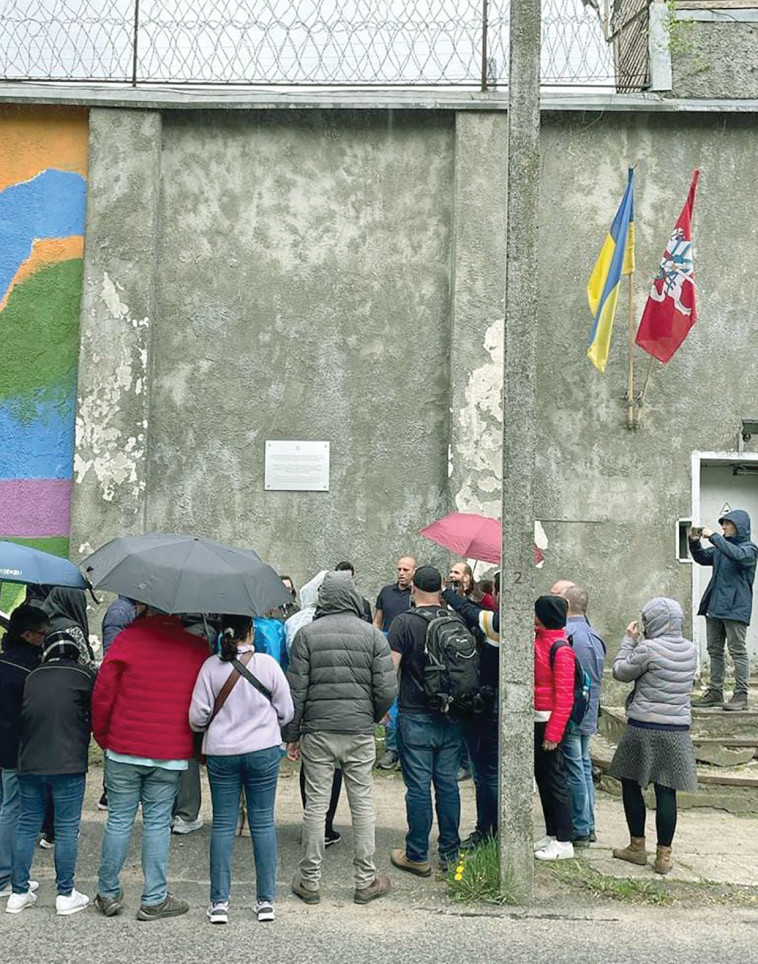 Riga, Latvia (Photo: Matan Wasserman)