
Just two years ago, BYD and Geely were unknown names to car buyers in Israel, with no showrooms in Israel. And here, in the summary of vehicle sales in the first half of 2023, the BYD Eto 3 ranks first by a wide margin with 9,400 units released, and the Geely Geometry C ranks fifth, with 4,500 units. Both express two revolutions that are currently taking place in our car market: the electric and the Chinese. One out of six new cars sold this year in Israel was electric, and one out of five – made in China.
The Israelis welcomed the unfamiliar Chinese electrical brands. Is it the growing awareness of the climate crisis, or the feeling of "beating the system"? Along with zero pollutant emissions from the exhaust – but considerable emissions from the power plants that produce their electricity here from coal and gas – the trams offer lower usage costs. Electricity is cheaper than gasoline and there is no tax on it, the costs of treatment are low, and the state gives them a significant benefit thanks to an annual license fee of only 570 shekels, about a third of what you would pay for gasoline jeepneys in the dimensions and price of the BYD and Geely.
Geely was the best-selling electric vehicle in Israel in 2022, when it was the first to offer an electric crossover at the price of a hybrid Toyota Corolla. But the competition in the market is great, and less than two years after its arrival in Israel, it receives its first facelift, with cosmetic updates and the passenger cabin, and minor improvements to the propulsion system and safety systems. Can the facelift bring her back to the top of the sales chart?
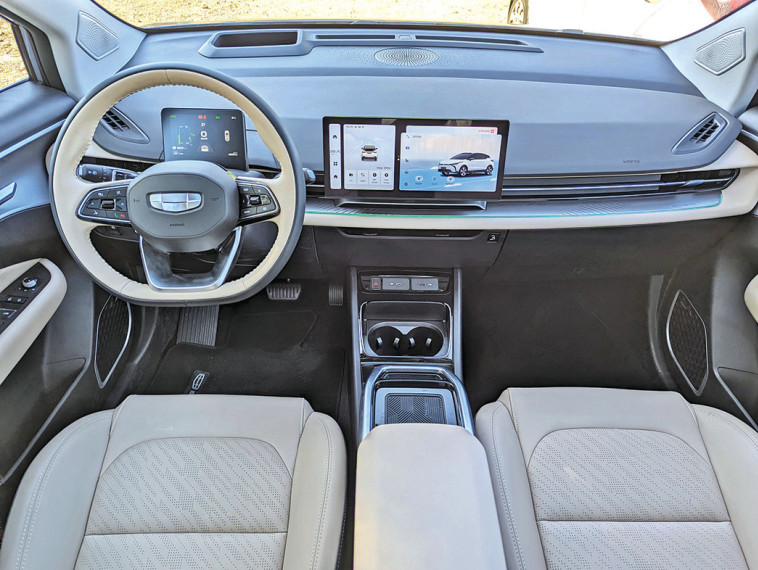
 Jelly Driver's environment (Photo: Keinan Cohen)
The dimensions of the Geometric C and Hato 3 are similar, with the BYD being two cm longer, three cm higher, four cm wider, and looking more Jeep. While the Hato 3 is more Jeep, the Geely is more of a crossover , and closer in dimensions to a compact family car.
In the upgraded passenger cabins, the Geely came in brown and beige colors, the BYD in gray and white with colored dots. The coloring testifies to the thinking: the Geometric still looks spacious and advanced, including a large multimedia screen as part of the facelift, the gear selector has moved from a dial on the central console to a handle next to the steering wheel, and the floating console has been partially eliminated, so that the cup holders and USB sockets are more accessible.
BYD is less conventional, which is felt in the design of the air vents that can be confusing, in the gear stick resembling the throttle of an airplane, and in the strings in the storage compartments in the doors, which will allow children to play on the parents' nerves. You can change the position of the huge multimedia screen to horizontal or landscape, the voice operation is more advanced, and there are more choppers. There are those who will like the abundance, there are those who will find it ornate.
 BYD driver's environment (Photo: Kenan Cohen)
As the dimensions suggest, the seating position in the Eto 3 is significantly higher than in the Geometric C, which also makes it easier to get in and out and care for toddlers in the back and its front seats are more comfortable.
The back seat in the Geely enjoys slightly better knee room and is also deeper, although the BYD has 2 cm more in the wheelbase. But the headroom, the width and the flat floor give priority in this section to the BYD, which can better handle You drove three toddlers in restraints, with a seat width of 1.34m vs. 1.30m. Both have rear air con outlets, but the Lato has 2 USB ports, one of each type. The Geely only has one, a mini.
In the trunk, the Eto has a slight advantage in volume, 440 liters compared to 417 liters, but the Geometric has an important advantage in the form of a spare wheel.
Both are well equipped with the high equipment levels tested: light 18-inch rims, sun windows, leather-like upholstery, wireless charging for cell phones, electric driver's seats, huge screens for multimedia and operation (14.6 inches in the Geely after the facelift, 15.6 inches in the BYD ), and a modest 5-inch screen as a dashboard in front of the driver's eyes, LED headlights and peripheral parking cameras.
Geely has a successful overhead display, BYD has an electric rear door. Only BYD has Apple CarPlay and Android Auto, a capability that was added in recent weeks to cars already driving in Israel through over-the-air (OTA) updates, a capability that Geely does not have – it still does not have both, and is content with the Wise application installed on its multimedia screen. Both have apps that allow you to remotely monitor the state of the battery and charging, for example, but only in BYD can you remotely turn on the air conditioner before getting into the car, like in Tesla.
Both models have a high level of safety equipment, including autonomous emergency braking, adaptive cruise control and lane departure correction. The facelift added a rear cross traffic alert to Geely, but BYD also has emergency braking in reverse, and a score of 5 out of 5 stars in the European crash test. The Geely has not yet been tested in Europe, but received 5 stars in the corresponding Chinese test.
With the same power and torque figures, the performance of both is excellent, with a very slight advantage for the Geely. In the range test, the Geely achieved a consumption of 19 kWh per 100 km, compared to 17.5 kWh in the BYD. But a 20% larger battery gives the Geely a longer range, about 400 km In a calm intercity cruise compared to about 350 km in the BYD. The Geely's official range figure was improved following the facelift from 460 to 480 km, one of the longest in its price group. Both can be fast charged, with a faster rate in BYD – 90 kilowatts per hour compared to 70.
While the Geely is a gasoline car that has been converted to electricity, the BYD was designed in advance as such. The BYD has a bit more grip than the Geely, which suffers from even more detached steering. Both are unimpressive in the road handling section, and will be inferior to equivalent gasoline Jeeps. The BYD presents superior ride comfort.
Bottom line, Geely has an advantage mainly in the range and existence of the spare wheel, and also in the existence of versions with reduced equipment and even with a smaller battery, but at a more accessible price of NIS 145,000.
But the victory goes to BYD, thanks to better clearance, improved usability, better equipment, better ride comfort and certainty about the crash test. The Hato 3 falls short of the Geely mainly in range, a matter that is partially balanced by a faster charging capacity. It also has a cheaper base version, at NIS 12,000, without an electric door in the back, without the possibility to charge electrical appliances and other cars from the charging socket, and with only a 12.8-inch screen. Either way, it's a better family Jeep.