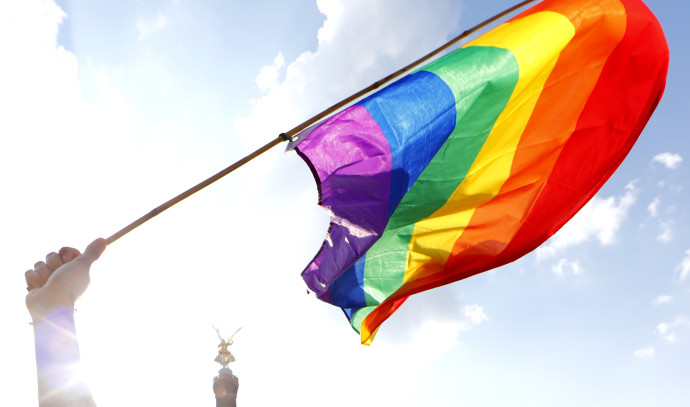

The openness and inclusion of the LGBT community in Israel has come a long way in recent years, yet the members of the community still have to deal with many difficulties and discrimination, which sometimes leave them with mental scars. On the occasion of the excellent month of pride, Tzur Brosh, a clinical psychologist at the United Health Fund and the mental health center in the alignment Muehedat's LGBT medicine, explains the unique needs of the community members.
Do you think members of the community need mental help more than the average person?
Definitely yes. But this is entirely because of the way LGBT people are accepted by society, and not because there is anything 'problematic' about being LGBT. A long series of studies in the world found increased rates of depression and anxiety in LGBT people compared to the general population. Even suicide rates were found to be significantly higher in LGBT people compared to the general population. For example, a review by the Australian National LGBT Medical Organization reports a suicide attempt rate 15 times higher among LGBT people compared to the general population. These are horrific data and anyone who opposes the acceptance and rights of LGBT people should know that this is what it means. It is important to note that the studies clearly show that it is not the sexual orientation per se that produces the mental distress, but much more the way in which LGBT people are accepted by society and family over the years , since childhood.
Since childhood?
On the one hand, the LGBT community is part of a long line of social minorities in Israel and around the world. On the other hand, the LGBT community is a unique social minority in two main characteristics: the first is that the members of the community are almost always born to parents who are not members of the community (as opposed to, for example, a son born to an ethnic minority to parents of the same minority). The second is that the self-identity is perceived by the environment, and many times already from childhood, as 'unacceptable' or as something that works against the 'natural order of things', and hence is attacked in various ways. Therefore it is also not surprising that LGBT people report in studies more negative childhood experiences such as bullying and social rejection at school age or a feeling of not belonging already as children.
Many LGBT people recall during therapy certain moments in their childhood when they suddenly realized that something in their behavior contradicted the expectations of their parents or the environment, as well as the negative reaction of the environment to that behavior. In those moments the child understands without words that there is something 'different' about him, and that the difference This within him is 'attacked' by those people he is related to and whom he loves. A child from an ethnic minority who suffers discrimination and racism at school, can at least feel inside his home the same and similar to his parents and siblings, and thus feel a little more protected and able to face that racism. An LGBT child Not only is this also missing, but the 'racism' is directed at him many times inside the house, by his parents and close family. This is a unique characteristic of the LGBT minority.
In addition, the problem with violence and lack of acceptance towards LGBT people is that in mental processes external negative experiences are recognized and internalized and become self-criticism, low self-image, body image problems and internalized homophobia. If enough people tell and broadcast to me that there is something wrong with me being LGBT, in the end I will start telling myself that. From here the path is very short to increased rates of depression and anxiety. So it is important to emphasize again that it is not the sexual orientation per se that produces the emotional difficulty, but rather existing social structures, social discrimination and social 'norms' that produce and contribute to these difficulties. There is no doubt that the need to create a change in the existing structure in relation to the needs of the LGBT community is also true in the field of mental health.
But why do they need tailored services and can't "make do" with those provided to everyone?
Over the years, medical services have been adapted to different populations, either to women who need adapted medicine, or to different populations such as the Arab or ultra-Orthodox sector, for whom, the medical services are adapted according to their lifestyle and faith. In recent years, the understanding began that the LGBT community also needs adapted medical services, especially when it comes to mental health.
We see that community members are sometimes afraid to seek medical or mental health care, mainly out of fear of rejection, stigma or disrespectful treatment. Beyond the barriers to receiving medical treatment, this is a community that sometimes suffers from unique medical problems, some of which are related to mental health, such as dealing with depression at increased rates, anxiety, eating and body image disorders, loneliness, and more. A. Women on the trans spectrum are also a group with unique needs, and a need for professional accompaniment in the processes of gender adjustment at its various stages, as well as the emotional support required as part of dealing with the change processes and with the environment's acceptance of the gender change.
Out of an understanding of the unique needs, and of the concerns that LGBT people have regarding health services, a complete set of LGBT medicine was established at the United Health Fund headed by Dr. David Shesha. A set that includes doctors from various fields, as well as therapists from the field of mental health and social work .
How do you match them with the right service?
LGBT people report all kinds of concerns about seeking psychological treatment. People who are still in the closet and are not open about their sexual orientation are afraid to seek treatment in order not to raise unnecessary questions in the environment for them. For this we have a complete set of mental therapy on Zoom or three phone calls with someone Treatment, so that even those who are in a remote place in Israel, or who do not want to visit a clinic in Israel, can receive treatment. This is at the same time as face-to-face meetings with a psychologist in the clinics.
Out-of-the-closet LGBT people also report a fear of criticism from the therapist towards their sexual orientation and their choices. Fortunately, today the criticism appears less as a lack of acceptance on the part of the treatment personnel, and more as an 'understanding' of the patient through 'glasses' and concepts from the 'straight' world (concepts Adapted services are designed to solve exactly this problem, and teams that provide services in an adapted framework undergo dedicated training for the purpose.
Beyond that, many LGBT people sometimes feel that they have to explain to their therapist basic actions and issues in their lives related to the LGBT world. The need to explain to the therapist basic concepts in your day-to-day life restores to the patient the feeling of not belonging and he again feels that he has to adapt to the environment. For example, many transgender patients sadly describe the need to explain basic actions, struggles and needs to their psychologist at the start of treatment, instead of the therapist having the same basic knowledge in advance. Hence, in order to accurately treat community members, it is necessary to know a whole world of unique concepts, actions and norms. A team that has gone through trainings knows very well the unique needs of the community members and offers emotional care that is conscious, attentive and culturally sensitive. Beyond that, sometimes the treatment team also acts as an intermediary between the patient and other care providers in the community (family doctor, dermatologist, etc.) and thereby helps the patient feel more at ease.
What treatments are these?
The range of treatments in the mental health system in general, as well as those adapted to the LGBT community, includes psychiatric, psychological treatments – individual and in groups, social workers, rehabilitation workers, speech therapists (for example, working with people undergoing gender change who wish to also work on gender adjustment of the voice), Expression and creation and more.