Hidradenitis supertiva (HS) is a chronic inflammatory disease of the hair follicles. The disease is characterized by painful inflammatory lesions called "nodules" or abscesses, which usually appear in the fold areas such as the armpits, groin, or between the buttocks, but can actually occur anywhere in the body where hair follicles are found. The lesions are accompanied by intense pain and a purulent discharge that emits an unpleasant odor and tend to pass and recur at times, initially leaving spots or light scars and later with a tendency to the appearance of scars and structures known as canals that regularly secrete pus, causing a complete deformation of the infected area.
"A sister in heart and soul": the friend of Bat Sheva who was murdered in an attack says goodbye in sadness
Uproar due to the story of the 14-year-old who was forced to cover up on the bus: "Sexual harassment for everything"
This is a disease to which the tendency is hereditary-genetic. The exact mode of inheritance is still unknown, only 30-40 percent of cases have a clear family history.
This is not a rare phenomenon. The prevalence of the disease is estimated at about 1% of the population. On the other hand, for many years hidradenitis was called an "orphan disease" due to its being neglected, unknown and therefore often undiagnosed. One of the main reasons for the delay is that people do not always share the symptoms they experience, as the disease often involves intimate places.
Another reason is the medical system's insufficient awareness of the disease. The typical scenario is one where patients wander in despair between a variety of doctors ranging from family doctors, surgeons, gynecologists and others and are treated with various antibiotics or surgical drains with a misdiagnosis of bacterial pornoculosis. The average time from the onset of the disease to the diagnosis is about seven years!
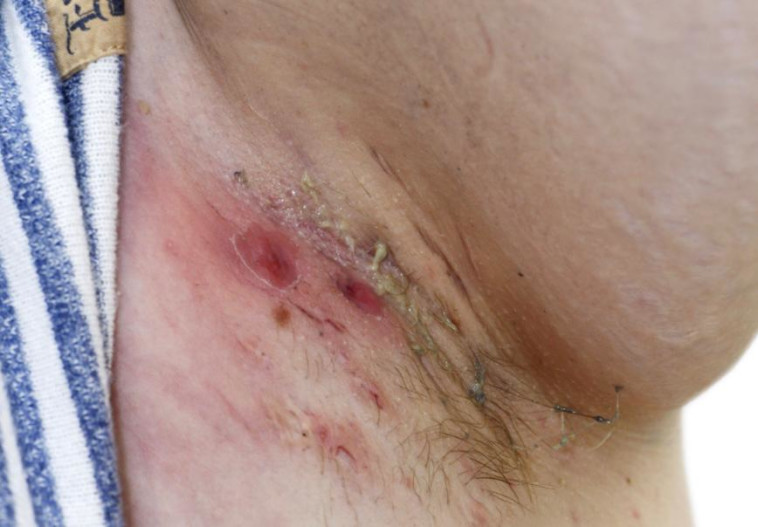 Armpit of a patient with the skin disease hidradenitis sportiva (Photo: SCIENCE SOURCE)
This delay, in addition to the unnecessary suffering of the patients, may lead to the diagnosis of the disease already at an advanced stage where irreversible anatomical damage has already been caused to the skin .
At the same time, due to the nature of the disease and because it involves repeated attacks, there may be a situation where the test is normal during the visit to the doctor even though it is an active inflammatory disease.
Another reason is that, as I mentioned before, this is a chronic disease. It takes at least two events over six months to make a diagnosis of hidradenitis suppurativa, so it is not possible to make a diagnosis when the first abscess appears, but you have to follow the patient for several attacks, and it is not possible to make a diagnosis the first time an abscess appears.
Besides the genetic background, there are several triggers that worsen the disease, the main ones being smoking and obesity. In the presence of excess weight there are more folds and more sweating and friction. In addition, it is now known, and this is true for many other inflammatory diseases, that the fat cells, especially the abdominal fat, produce substances that encourage inflammation, and therefore people who have lost weight respond better to treatment.
Friction also worsens the disease, so it is recommended to avoid tight clothing and underwear, and minimize prolonged sitting as much as possible. Shaving and waxing also cause constant friction, so laser hair removal is recommended.
The disease also has a hormonal factor – the disease is 3 times more common in women, usually appears during puberty and fades towards menopause. In women who tend to flare up before or around the period or with co-morbidity of polycystic ovary, it is recommended to add treatment with combined pills. Progesterone-only pills or hormone-releasing intrauterine devices should be avoided.
How are you treated?
Since it is a chronic disease, regular treatment is necessary. The treatment varies according to the severity of the disease. In mild cases, you can be satisfied with washing with antiseptic soap and applying ointments in combination with a lifestyle that treats the aggravating factors: reducing friction, losing weight and avoiding smoking. In more severe cases with frequent flare-ups of abscesses, it is necessary to treat with oral antibiotics for a prolonged period.
It is important to note and emphasize that this is not an infectious disease and that the antibiotics chosen for use in this disease are those that have anti-inflammatory activity. Such treatment may result in prolonged remission. In cases where oral antibiotics do not bring improvement or even if they are effective but there is a rapid flare-up after the end of the treatment – there is a place for regular anti-inflammatory biological treatment.
When there is already anatomical damage to the skin, surgical intervention is necessary. In cases of localized disease, laser treatment or excision under local anesthesia can be performed. In more severe cases, a wider excision is necessary. It is not recommended to perform surgical drains, since beyond momentary relief they do not affect the course of the disease and may even help in the formation of canals or scars.
Hidradenitis supportiva is a disease that significantly impairs the patients' daily functioning and is accompanied by a severe psychosocial impact. Patients with hidradenitis suppurativa have a higher incidence of disease-related absenteeism and unemployment than any other skin disease. Also, there is an increased prevalence of depression, suicidal tendency and disturbance in interpersonal relationships compared to the general population.
Early diagnosis and treatment combined with regular and close medical follow-up can prevent the disease from progressing to irreversible stages and allow patients a good quality of life and normal functioning in their personal and professional lives.
The author is an expert in skin and genital diseases at the "Ichilov" medical center