1. The postponement method
In the interviews of the last few days on the half year anniversary of the Netanyahu government, the government ministers made sure to quote the phrase "the cost of living". Since half a year was not enough to treat the problem, they are asking for another six months grace, after which we will judge them. These are the pages of messages that come from Finance Minister Bezalel Smotrich, Culture and Sports Minister Miki Zohar, Economy Minister Nir Barkat, Chairman of the Economy Committee, MK David Bitan and many others.
I will content myself with a quote from Smotrich: "The fight against the cost of living is at the top of the agenda, and I am determined, together with you citizens of Israel, to win this fight. We will continue to ease the economic burden, along with maintaining agriculture as a national and Zionist value of the highest importance." Nice. But another six months For the government it is an eternity. They were not willing to give the government of change a month. What month? Even one day. The Minister of Transportation Miri Regev was ready to stage an accident with many casualties and fry the club on its occupants in order not to give a chance to even humanitarian legislation for soldiers or rape.
 Finance Minister Smotrich (Photo: Yonatan Zindel Flash 90)
But even if the government gets half a year and another year on probation, without a fundamental change in the cost of living system, nothing will happen. What is now known as a war on the cost of living is a collection of improvisations, temporary solutions and transfer of funds from side to side. The program includes spot-on responses to problems that are flooded through the media or in consumer programs on television. There is no long-term determined policy to lower the cost of living, because it requires hard work. The treatment is at the level of improvisation, and the result is worse than a temporary visit to a dentist.
What is the cost of living? It is common to think, and quite rightly, that these are the prices of food (Milky's price in Berlin), toiletries (Colgate toothpaste price at Superpharm in Warsaw) or milk prices. Food prices have a pretty good PR, and at the agenda level they get VIP treatment. In the field, almost nothing was done, except for cosmetic solutions.
Let's take the story of the shortage and milk prices. The Minister of Finance violated a signed agreement with dairy farmers two months ago and prevented a 16% increase in milk prices. As a result, it did not pay for the dairies to produce milk and there was an acute shortage. Tnuva ("the threatening monopoly") has taken over the market, and 80% of the white liquid is marketed by it to chains. And what does the Minister of Finance do? Instead of implementing a root solution to the shortage, he goes over the heads of the farmers and pulls out a "miracle solution" in the form of opening the import of milk to Israel without 40% duty.
It's a populist solution at the level of a Twitter tweet, which in any case will not come to fruition. Even the previous Finance Minister Avigdor Lieberman would not have dared to make such a move, and this time it was made over the head of Agriculture Minister Avi Dichter, from whose direction crickets are heard. No business entity such as Shufersal, Rami Levy or Williger will get involved with regulatory, kosher, transport and short shelf life costs in importing milk for three months. So maybe the time has come to subsidize the dairy farmers as is customary in the enlightened European countries? Next: Prescription drug prices were going to increase by 4-5%. so what are we doing? A panacea is being found in the form of a section in the Ministry of Health's budget worth NIS 40 million to prevent the move.
 Rami Levy (Photo: Mirim Elster Flash 90)
Economy Minister Nir Barkat appeared before the Economic Committee this week and presented his plan to combat the cost of living: "We will move from a monopolistic system to a competitive market," he promised and detailed: "What is good for Europe is good for Israel, dismantling monopoly, fines, financial reports and a revolution in public service." At the level of statements this is excellent, but it is interesting to check how these reforms will affect the prices of hair conditioner or toothpaste tomorrow. MK Bitan, who hates plans on ice, demanded immediate solutions. "Dror Strom promised to break up the banks and it's been a decade and nothing has moved," he added.
 Nir Barkat (Photo: Mark Israel Salem)
But as mentioned, the cost of living is not only food and toiletries but also transportation and energy. Here the procrastination method works overtime. The prices of public transportation were supposed to jump by 12% this month due to the increase in the price of fuel and wages. so what are we doing? The move is being postponed for a month, until then they are trying to find a budget section for NIS 100 million to prevent the move. And what's next? God is great.
Gasoline prices are a prime example of the peak of the cost of living spiral. Until half a year ago, it was customary to determine the price of gasoline once a month according to a fixed formula that takes into account the prices of fuel in the world, the excise dollar and the VAT. Gasoline price guesswork. Prices have stabilized in recent months at 6.85 shekels per liter of gasoline thanks to a partial reduction of the excise tax. Without transparency we will not know how much the "creative" solution costs the state, but the Treasury refuses to disclose data.
The electricity rates that are supposed to be determined by the Electricity Authority are another example of the creativity of the Haltura. The price decisions were actually expropriated from the Electricity Authority, and the prices are determined according to political considerations. So what did we have? Bibi promised that the price of electricity would decrease, but at the beginning of 2023 it increased by 8.2%. In April, the price was reduced by 2.4% in an advanced accounting trick, and it is possible that in September it will be reduced by another 3.5%, if the Eshkol power plant is sold for NIS 10 billion and the money finances the reduction. How is any sane industrialist able to plan over time the production costs with such uncertainty?
And with all due respect to food, energy and transportation, we still haven't talked about the elephant in the room regarding the cost of living – which is housing prices that are not going down. The only meeting of the Housing Cabinet chaired by Minister Yitzhak Goldknopf on the issue of housing plans dealt, of course, with subsidizing apartments of up to NIS 600,000 that are particularly suitable for the ultra-orthodox audience. Netanyahu asked the Minister of Housing to revamp the plan, and the Minister of Finance revealed: "We are working on a very big plan. We need to lower prices, our big challenge is to maintain the pace of construction, between 70-80 thousand starts. A few more years like this and the prices will drop."
wow In a few years housing prices will fall. Minister of Finance: Please, be a little more up-to-date. I have been hearing the Hasidic chants of lowering housing prices since 2010 during the tent protest, but in the meantime the prices have doubled and even more than that.
Bottom line, and with all due respect to the cost of living, it is not always possible to lower food, energy and even housing prices, because we are part of an international economy. If the dollar has strengthened since the beginning of the year by 6% or more because of the legal revolution, this is the price of preserving the Netanyahu coalition at the expense of the cost of living. If you want to preserve agriculture, and this must be the case, farmers and dairy farmers must be subsidized. If you want to make it easier for the weaker sections, the treasury officials will be asked and they will halve the VAT on basic products (and not just on fruits and vegetables) which will be under supervision and ensure that all the VAT will be passed on to the consumer.
When talking about price differences between Tel Aviv, Warsaw and Berlin, one must take into account rental costs (property tax which depends on wages in the public sector), water prices (which rose by 3%), indulgent wages with generous labor laws, transportation costs and traffic jams in the ports. Smotrich is an unconventional finance minister who is able to erase not only Hvara, but also brokerage and bureaucracy gaps. But the cost of living requires inequality-breaking measures outside the settlement box and not just bragging tweets on Twitter. The Settlement Law was the last opportunity for change. If he still manages to do something, we will be the first to applaud.
2. The governor's catch
Next Monday, the Monetary Committee at the Bank of Israel, headed by Governor Prof. Amir Yaron, will publish the interest rate decision. Spoiler: it will remain unchanged and stabilize at 4.75% per year. A press conference will be held later. The ever-increasing current affairs topics will be on the agenda.
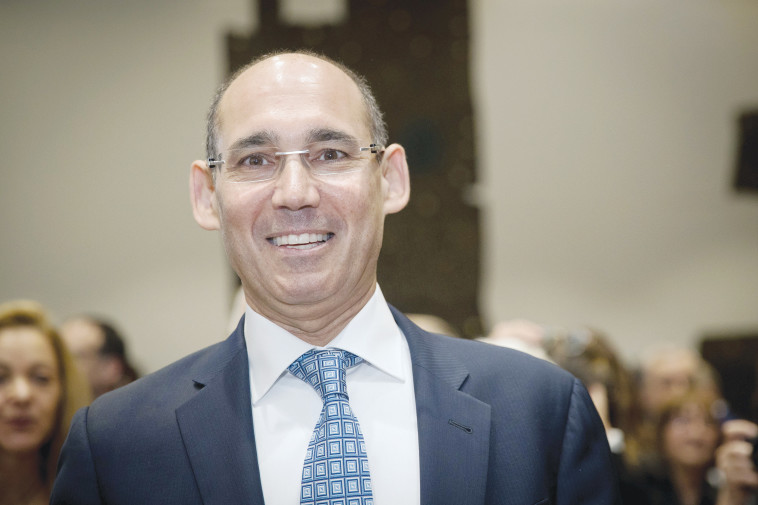 Amir Yaron (Photo: Yonatan Zindel, Flash 90)
There are weighty reasons to keep raising interest rates. The dollar rises like a hot air balloon along with the progress of the revolution, and this week crossed the 3.7 shekels. Employment is tight, and the demand for personnel is renewed. Wages are rising, and the credit card companies are reporting an increase in the fever of ironing plastic cards. The economic data contains the potential of a future inflationary outbreak.
So although the May index was content with 0.2% thanks to moderation in demand in the consumer sectors, it is a one-time index, because the June index will be higher and so will July. Inflation stabilizes at 4.5%-5% per year and contrary to the mikvah – it will not converge to the target until the end of 2023 (up to 3% per year). Even in the international financial sector, a headwind is blowing for raising. Although the American governor did not raise interest rates last month, two increases are expected by the end of 2023.
In Europe, on the other hand, interest rates continue to rise. So why won't the interest rate go up here, even though under objective circumstances it was expected to happen?
So it is that Prof. Yaron has found himself in circumstances that include an unprecedented wave of populist attacks not only from politicians (by the way, on both sides of the map), but also from people in the business sector, including the president of the Union of Chambers of Commerce, the president of the industrialists, the chairman of the umbrella organization of the business sector and president The independents believe that the interest rate has exhausted itself and alternatives must be sought to fight inflation.
There is something in their words: a jump in interest rates from 0.1% to 4.75% within 15 months is a scenario that the business sector, let alone the households, would not have been able to prepare for. One of the problems that the move has caused is the surplus copy profits of billions of additional shekels that the interest rate hikes yielded to the banks. The Minister of Finance covets the profits, which come to his taste at the expense of the recipients of mortgages and overdrafts, while depositors are content with crumbs. Although this is a decision under the sole responsibility of Prof. Yaron, a change in the interest rate will provide ammunition to his increasingly numerous opponents.
The next interest rate decision will be made on September 4 (a few days before Rosh Hashanah). This is an interesting date, because by then the governor will announce whether he intends to continue for another term. Inside he would like to, but it will not come out until he receives an official appeal from Netanyahu. But Netanyahu doesn't come and doesn't ring the bell.
Assuming that the governor announces that he is not interested and decides to abandon it, he will function until the end of 2023 on a lame duck basis. This is not good for Israel's position in the world, for the economy and will create enormous uncertainty, especially regarding interest rates. That's why you shouldn't wait until September and you have to decide already during August if the governor continues or not.
3. The race for the board of directors
The former president of the Jerusalem District Court, retired judge David Cheshin, has been the focus of public criticism in recent weeks. He heads a committee for appointing directors in banks (without a controlling interest), and many have a claim about the lack of transparency in this committee. For example, appointments such as that of Moshe Barkat, former commissioner of the capital market and insurance and chairman of the Phoenix, which were not approved. Those who did succeed the committee were Sigal Regev, former CEO of the United Health Insurance Fund, and Shlomo Mor Yosef, former CEO of the Population and Institutional Authority National Insurance.
 David Cheshin (Photo: Liora Cheshin)
Judge Cheshin will finish his position as chairman of the committee at the end of next month (August) after a three-year term (he replaced Judge Moshe Gal). He is not interested in continuing in the position, and just before that he leaves to talk about the set of considerations pertaining to this powerful position. The members of the appointment committee are Prof. Momi Dehan and attorney Orit Keren, former deputy legal advisor to the government. In addition, when an appointment at a specific bank is on the agenda, two additional members from that bank join the committee.
Few personal details that are not yet exposed to the public. Cheshin, 74, is going through a sad period in his life after the death of his wife two months ago. He is the ninth of ten children, a member of an ultra-Orthodox family. His brother, Zvi Cheshin, is one of the leaders of the Mir yeshiva in Jerusalem.
Why did you take on the role of chairman of the appointments committee?
"The position was offered to me because the law states that the committee will be headed by a retired Supreme or District Court judge. My salary as chairman is NIS 2,000 per meeting, and the members' salary is NIS 1,600. The law states that a bank's board of directors shall appoint no less than 7 members and no more than 10. We are a committee that examines the candidates who apply to us. We are not a locating committee but a recommending committee. The recommended candidates come to the approval of the general assembly which chooses from the list."
Why do you need a committee? Why are directors not appointed as is customary in the companies law?
"What characterizes the banking corporations without a core of control is the dispersion of shares among many shareholders. We need to recommend, not the shareholders, to make sure that at the head of the banking corporations there are people whose duty is to the stability of the bank and its success before any other consideration. The main role of the committee is to propose to the assembly to the General Board are candidates for the position of director, and this is in order to avoid difficulties in appointing directors due to the large number of shareholders who each hold a minority. To reduce the fear that a minority shareholder will gain control of the bank without obtaining the approval of the Bank of Israel."
There are jarring cases in which serious officials were not elected, such as Yossi Sharid, who ran for the Laumi position even before you entered, or now Moshe Barkat.
Why?
"We have one way of choosing who to choose, if a person comes and has had a serious role in the Israeli economy, we examine his relativity to others and his record. The legislator determined the way and the procedure, and part of the decision process is the personal impression of the candidate, whether he is suitable in terms of Leadership, knowledge of the field, horizontal view of the economy, the ability to lead changes and more.
"In the committee's considerations, the position of the bank representatives, who have experience as incumbent directors and should be given weight, is taken into account. We have reservations here and there, but I do not focus it on business temperament or other reasons concerning the candidate. All these things are ultimately weighted for the score of each member of the committee awarded to each candidate. At the end of the day, the score given to each candidate is counted, and whoever received the highest score is recommended."
But there are cases like that of Stanley Fisher, the former governor, who at first was not assigned but then, following the intervention of the Bank of Israel, he was recommended to the Bank Hapoalim board of directors and in the end he disappeared.
"I have heard of this, but it was not during my time. I am not aware of any cases in which the Bank of Israel or external parties interfered in the appointment of directors. There is no influence at all on the selection of those recommended. Before each assignment, the supervisor of banks updates the members of the committee with relevant data on that bank assigns, the challenges of the bank and what their needs should be emphasized. During my time, I requested that this update arrive in an orderly and written manner so that we can deal with things with the due seriousness. This update that the supervisor gives us does not concern this or that candidate or the nature of the optimal candidate, but considerations that are stepping stones to the selection .
"The law stated that we should be an independent and independent committee, and therefore I receive all the information – and the committee I chair decides independently. Each member of the committee is experienced and has discretion. The scoring is personal and independent of the scoring of the others. A certain person was not included because the members of the committee They believed that in that round there are people who are more suitable than him. This does not say anything about the candidate and his abilities, and it does not mean that in the following rounds he will not be able to be elected."
Are there any cases where bankers requested that the committee initiate a personal appeal to this or that person so that he would submit a nomination?
"I never agreed to this, and there was never a personal appeal by the committee to the candidates. In my world view, the very appeal is discrimination in favor of one candidate or another. There is a call, and any person who considers himself worthy may submit a nomination. The law does allow the committee to appeal, but I strive for everyone to be equal before the committee – and this prevents me from appealing to one yes and one no. Sometimes I am heartbroken when deserving people are not included in the final list, but I cannot change the procedure."
Recently, you also include in the list of criteria the ability to serve as chairman, this in light of the expected retirement of the chairman of Discount Bank and Bank Leumi?
"In the call for nominations, we note the fact that the chairman of the bank may also be chosen from among the new candidates. The general meeting is the one that elects the directors, and the board of directors is the one that elects the chairman from among its members – so the influence we have on the process is indirect. In such a round of selecting recommended people before the chairman retires, it is taken into account that one of the recommended people may run for the position of chairman If he is elected as a director by the general assembly. Samer Haj Yahya, who held a very worthy position, is about to retire from Bank Leumi."
Why not recommend more candidates, let's say five, and let the general assembly choose who is suitable?
"Such a recommendation is a violation of the rules of the game in order to give an advantage to someone specific, and I am a great supporter of the principle of equality and that everyone should receive the same and equal opportunity. Overall, I am satisfied with the selection process of the directors in the banks. There are exceptional cases, but there is definitely room for improvements."
4. The legal reform
Contrary to all estimates, Judge David Cheshin – who is a distant relative of Mishal Cheshin, the former deputy president of the Supreme Court – was not elected to the Supreme Court. He retired from the position as the president of the district court in Jerusalem, having previously served as the president in Haifa. At the beginning of the current wave of protests, Cheshin spoke at the Bima square in Tel Aviv, so his positions against the revolution are quite predictable, and it is still interesting to hear his insights.
Despite all your skills and experience, you were not elected to the top, and maybe this proves that the administrative reform is correct and the criteria should be changed? The judicial revolution was not born out of nowhere. Maybe it stems from a real feeling of deprivation, superiority, me and zero more?
"Exactly the opposite. I think that reform should be vehemently opposed. First of all, ask why legal reform is needed at all. This is not reform, it is regression. You are taking from the court tools that exist today and are accepted in every democratic country. The so-called 'Deri law' is contrary to the principle that personal legislation is prohibited , which by the way is also prohibited in the American Constitution. There were exceptions in Israel regarding the issue of personal legislation, as in the case of Vera Weizman (the pension of the widow of the President of the country).
"I am opposed to the regime revolution, because its content is threatening and terrible for me. It takes away and abolishes the fundamental values of the State of Israel. According to Montesquieu, the separation of powers is the basis of democracy. Because of the structure in Israel, the government that relies on a coalition of over 60 Knesset members, Practically controls the Knesset, which is the legislative authority – and it is impossible for it to also control the judiciary. This is the crushing of democracy."
And if it happens, what are the implications?
"Without a proper and clear separation of powers, there will be a trampling of human rights and a fatal injury to our liberal democracy: fundamental values such as the Declaration of Independence and human rights, and especially the Basic Law 'Human Dignity and Freedom' and the Basic Law 'Freedom of Occupation', will disappear. Judge Aharon Barak said they spread toxins, But also support the change of the reason of reasonableness in part. With all due respect to Barak, I am not ready to accept it.
"On the other hand, I agree that this tool is not automatic and judges should exercise discretion when and to what extent to use it. But the discretion must still be in the judicial toolbox, in the constitutional authority of the court and its discretion."
And there is still a somewhat justified claim that the Supreme Court is a members' club that does not reflect the diversity of the population.
"I agree with this claim. The fact that the Supreme Court has been operating for many years without having Mizrahi judges, who are more than half of this nation, is illogical and unreasonable in my view. At the time, an Mizrahi judge was elected to serve as president of the district court in Haifa (Judge Yossi Elron – Yash), and I was a partner in the committee that chose him. And yet, the revolution is not the way. I don't believe in breaking dishes."
What do you think of the coalition's initiative to abolish the statutory status of the Bar Association?
"There is severe criticism of the bar and an attempt to weaken it. I am against harming the status of the bar. Traditionally, they have two representatives on the committee for the appointment of judges and that is good. I cannot ignore the fact that in recent years there has been some corruption in the work of the bar and its senior officers – and this has drawn criticism. In this context, I will quote You are the Khazari who said, 'Your deeds will make you dear and your deeds will make you far.' The lawyers are irreplaceable. They are the officers of the court and they are the agents of information, and their important opinion cannot be ignored. The lawyers are the ones who walk the corridors and halls of the courts, they argue and manage cases in front of the judges, and their opinion about them is important ".
As a result of the non-convening of the committee for the selection of judges and a shortage of about a hundred judges, is a gray market of legal decisions developing due to legal procrastination? It is about mediation and arbitration, which is your occupation today.
"I don't call it a gray market, because these are legal and reasonable procedures. The arbitration law is designed for exactly that – handing over a dispute to an arbitrator. But I certainly don't feel comfortable with dragging it out in court, but you have to understand where it comes from. If a judge in Israel receives four times as much Cases from a judge in another country, so from here, among other things, there is a delay due to an impossible load."
Suppose they came to you and said, Honorable Judge Cheshin, what would you fix in the legal system if it were up to you?
"I would say that there are certainly things that can be corrected, such as postponing and adding standards, but they can be corrected using common sense and the existing tools and measures. There is no need to carry out a coup d'état. However, the revolution also brought with it a "positive thing" regarding citizenship. It made 50% of this nation stand On their feet, who came out to shout Hams and that they are anxious for the fate of their children and do not want to leave them such a country. The coup d'état put them in a real fear that an attack on the regime, on the grounds of reasonableness and more, would result in a fatal injury to human rights in Israel."