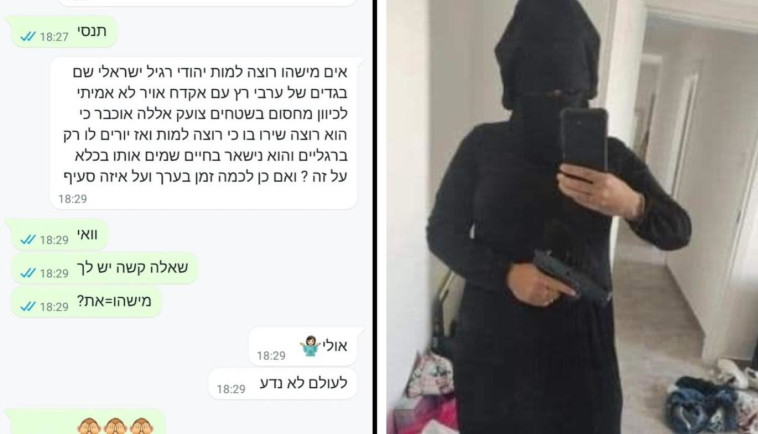

26-year-old Sapir Livnat Green is the young woman who was shot to death yesterday (Tuesday) at the Yatir checkpoint in Mount Hebron , after she disguised herself as a terrorist, allegedly to end her life. Green arrived at the checkpoint dressed in black, wearing a hijab, and was shot after brandishing an air gun and shouting "Allahu Akbar".
After a short time it became clear that the case was not an attempted terrorist attack on a nationalistic background, after her identity was revealed. At the same time, a WhatsApp conversation she had with an acquaintance a few hours before the shooting was revealed. "If someone wants to die, an ordinary, Israeli Jew, puts on Arab clothes and runs with an unreal air gun towards a checkpoint in the territories and shouts 'Allah Akbar', he wants to be shot because he wants to die, so they only shoot him in the legs and he stays alive, they put him In jail for that? And if so, for how long and under what section." After that acquaintance asked her if it was her, Green answered him, "Maybe." The friend alerted the police.
Green, who was a lone soldier and served two years and eight months in the military, dealt with mental problems over the years, and was hospitalized several times in the past. Even in her youth, she was known to the welfare services. About a year ago, she lost her best friend, Tikva Saban, who ended her life. Saban died at the end of the day where the two spent time together, after she swallowed an overdose of sedatives. Green, who was by her side, tried to resuscitate her, without success. The publicized case is remembered infamously for Saban's call to the police, and the conversation with the operator who implored her: "Just kill yourself already."
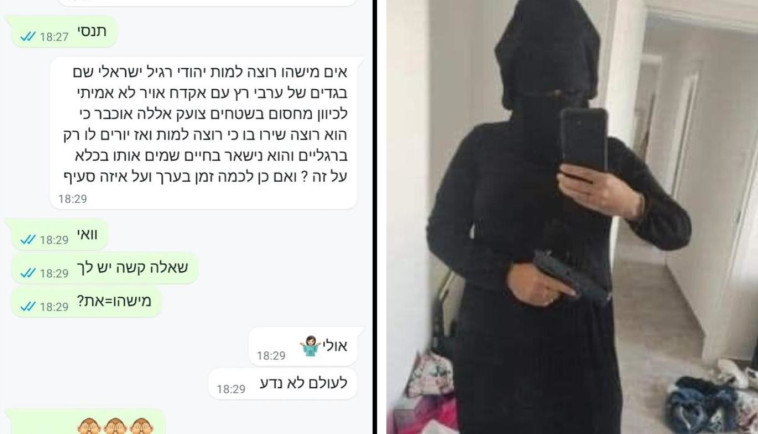 The documentation published by Livna Green in which she wears a hijab and the WhatsApp conversation before she arrived at the checkpoint (photo: use according to Section 27A)
Rin told about the incident about a year ago in an article broadcast on News 13. "We had a fun day in honor of my birthday. We agreed that I would sleep at her place so we went to her house and it was late. I waited for her in bed in her room and then she called me on WhatsApp and told me that she was in Satella and I saw all the ampoules of What the injection was. I called the ambulance and in the process she started convulsing. I tried to give her CPR. It was very difficult. She is my best friend. She tried many times to commit suicide, but I don't think she wanted to die."
She talked about the strong relationship with her best friend, with whom she shared their mental difficulties. "Something in the chemistry between us was good. She understood me and I understood her. She was like family to me. We both faced difficult situations. We can't go to work continuously. Even in mental hospitals they couldn't hold us. We have anxiety attacks in the middle of the day for nothing. Until That you don't hurt yourself, you don't relax. It distracts from the mental pain."
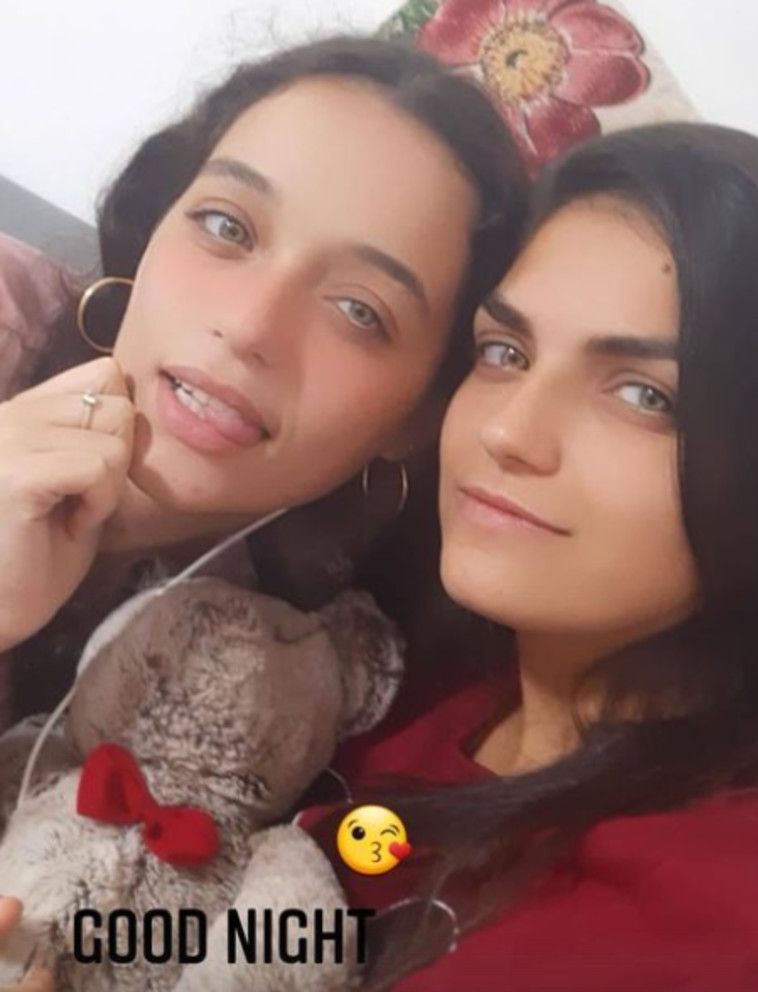 Livna Green and her best friend Tikva who ended her life (photo: use according to section 27a)
In the article, Green added: "My pain is enormous. I didn't function for a week. I didn't want to know that she wouldn't come back to life. I was left alone," and concluded: "I don't want to find myself dead just like that."
"At the time of Tikva's suicide, Livnat was next to her and tried to give her CPR and called the ambulance. She saw her friend die in front of her eyes," she told Walla this morning! Noa Grafi Cohen, who was her mentor in the emergency framework for girls at risk, and kept in touch with her over the years. "She has been through many traumas since she was a child. Severe sexual abuse, and in general came from a difficult family background. Her mother is a mental survivor herself, who is most of the time in psychiatric hospitals. Her father died 6 years ago from ALS, her brother also grew up in different settings Outside the home. Even when she was a girl she tried to hurt herself and the system didn't know how to deal with it."
Cohen told how Green, at the age of 19, against all odds, managed to enlist in the MGB. "She wrote letters that reached the Commissioner, and enlisted in the MGB for significant service. She had many difficulties in the army as well, but she had the ambition to prove to herself that she could. After finishing her service, she tried to integrate into workplaces, but was unable to last more than a few days. All the time there were behavioral and mental issues that caused her to be inconsistent."
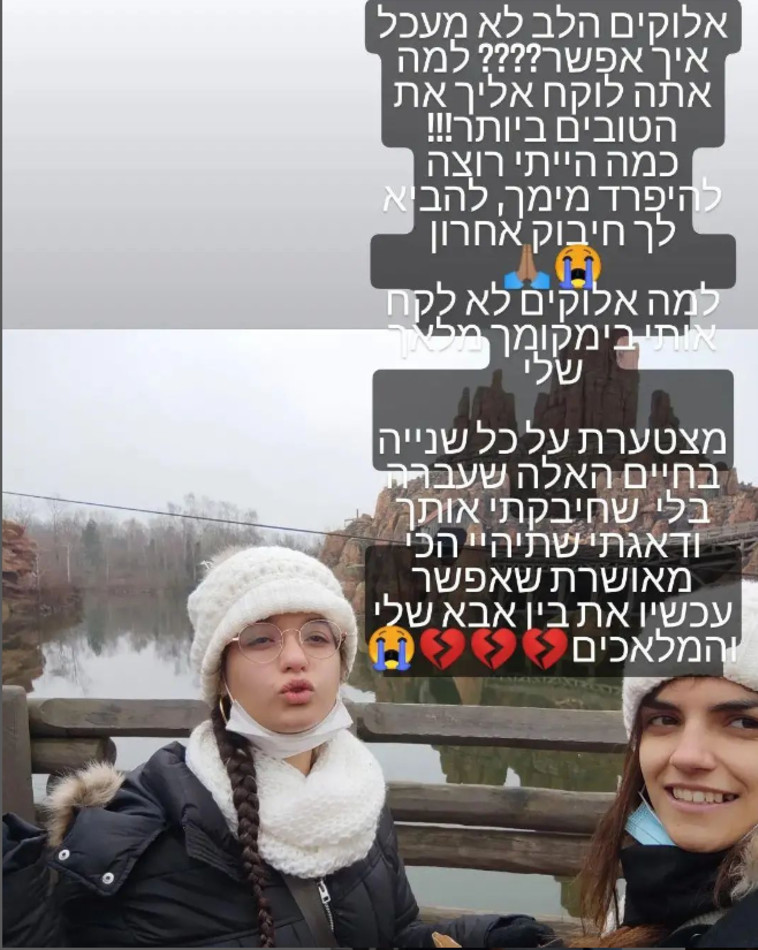 Livna Green and her best friend Tikva who ended her life (photo: use according to section 27a)
Cohen describes many years of obscurity on the part of the authorities. "She begged for a rehabilitation basket, and was on her way to receiving it. I am a social worker, and she asked me for bureaucratic help with this. A year and a half ago, she turned to me to help her get hospitalized. She told me that no one treats her anymore, they don't want her in a hospital because She has already finished the treatment. I turned to the psychiatrist begging her to accept her and she told me that she had already exhausted most of the treatment. Every few days she would upload a story on Instagram, of very severe self-harm. She had a strong desire to end her life. She was constantly at war with Sanity and rehabilitation, but the desire to stop suffering was stronger."
About two and a half years ago, during the corona epidemic, Green appealed in a post on Facebook, after she was evicted from the house where she was staying. "I'm contacting you because a week ago I was kicked out of the place I lived in that belongs to welfare in Be'er Sheva, without giving me time to organize to find a place to live, because I got sick with Corona. I went to the heart center that I know and welfare in Be'er Sheva and they didn't agree to give me any help and closed the door in my face Now she is unemployed and homeless. I came to demonstrate in Jerusalem in front of the Ministry of Welfare and she is sleeping here in a tent." The case received media coverage, and the Minister of Defense at the time, Naftali Bennett, even hosted her at his home.