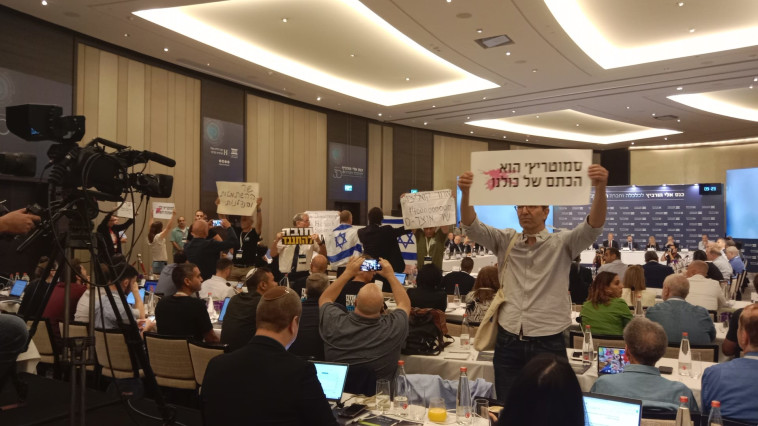

Against the backdrop of the approval of the state budget in the Knesset , the Eli Horowitz Economy and Society Conference is being held today (Tuesday) at the "Orient" hotel in Jerusalem. The conference is attended by senior government officials, including the Minister of Finance, Bezalel Smotrich , the Minister of the Interior, Moshe Arbel , the Minister of Education, Yoav Kish and the Minister of Labor, Yoav Ben Tzur . Also, the opposition will also take part in the conference, such as the head of the opposition, Knesset member Yair Lapid , Knesset member Benny Gantz and Knesset member Avigdor Lieberman .
Meanwhile, the conference will deal with a number of topics, including the future of the Israeli economy, the cost of living, central-local government relations, the future of high-tech in Israel, the development of branches that generate green employment and professional training for future skills and news in the public service.
The conference saw a silent demonstration of protesters, alongside protesters who attacked Smotrich during his speech.
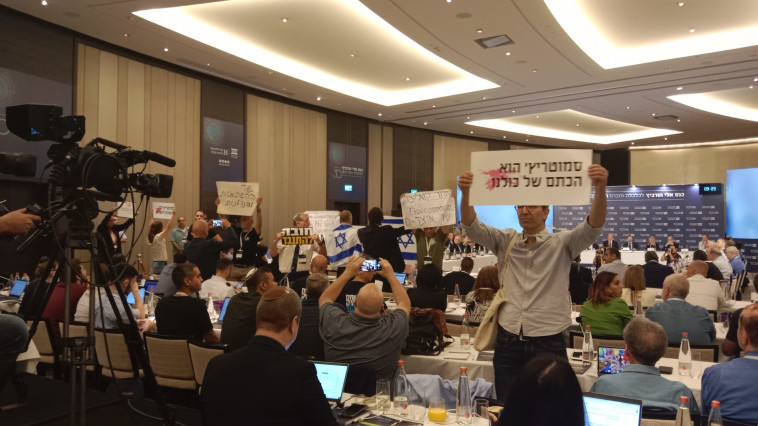 A demonstration at a conference attended by Finance Minister Bezalel Smotrich (Photo: Matan Wasserman)
Smotrich speaks at the conference: "I come to this conference knowing that some of the issues on the agenda will be agreed upon by those sitting here, and some will not.
My starting point is that Israel's economy is important to all present here and that is what I came to talk about.
The budget passed and with it the economic plan, and these carry a large number of plans that will jumpstart Israel's economy. In addition to this, these days we are working at the Ministry of Finance on a broad plan to accelerate the economy and promote Israel's economy.
I would first like to briefly present the global situation, followed by my policies as Minister of Finance, as reflected through four key vectors.
In the last year the global economy is in crisis.
The printing of huge sums and the grants given by countries during the Corona period, along with a temporary decrease in the consumption of services during the epidemic, created pent-up demand that erupted at the end of the epidemic.
The supply chain disruptions and the war in Ukraine that raised the price of goods and energy intensified the problem on the supply side as well and caused high and sticky inflation.
After about a decade of low interest rates, we have entered a new era – an old era of high interest rates where money is no longer cheap.
The new interest rate environment places the global economy in a risk zone. In the US, regional banks are collapsing, companies that have leveraged themselves are finding it difficult to show profitability. In France, for example, where food is a kind of religion, there was a drop of more than 10% in food sales at retailers compared to the level there before the corona virus, the commercial real estate in some of the city centers in the US is in crisis, buildings are standing empty and harming all the service providers in the city centers and many banks Those exposed to commercial real estate are in risk areas where it is difficult to assess the chances and scope of its realization.
The International Monetary Fund lowered its global growth forecasts to 2.8%
According to the fund's economists, in five years, global growth is expected to be around 3%, the lowest medium-term forecast since 1990.
The State of Israel led the way out of the global corona crisis for many reasons. Among them, the correct early identification of the epidemic and the preventive measures taken against its spread, quite correct navigation of the economy during the crisis and the grants to businesses that allowed them to stay afloat and return to accelerated activity immediately after the end of the epidemic, early follow-up of the vaccines, and an efficient public health system that proved itself in the operation The quick and effective vaccinations, but also thanks to Israel's export mix.
While the scope of tourism in Israel as part of total exports (the sector hit hardest by Corona) is low compared to other countries, the scope of high-tech in total exports in Israel is high and even reached 54% in 2021.
During the Corona days, following the restrictions, people found themselves working from home, consuming from home and relying more and more on digital services, which created growth in e-commerce and helped Israeli high-tech companies to show phenomenal performance.
This performance, along with high revenues from real estate transactions, increased revenues and reduced Israel's debt. The Moody's rating agency predicted a slow and prolonged return to the pre-crisis GDP debt ratio (60%). In practice, this happened in just one year. No one can was to imagine it.
But precisely what protected the Israeli economy during the Corona period creates an increased risk factor for us at this time.
A high interest rate environment, meaning expensive money, causes a natural market correction, but it is hard to ignore that Israel is in an even more dangerous area due to the fact that the high-tech industry is a leading and significant engine.
As I mentioned, more than fifty percent of the exports from Israel are from the high-tech sector and its affiliates.
The Israeli company was able to create a spectacular ecosystem thanks to human capital, a culture of initiative and creativity and a favorable regulatory environment.
But you should know, the high-tech industry is a venture capital industry and therefore is very sensitive to changes in the global financial system.
You know, I am an economic right-wing person and as a policy I believe that the market knows how to do its thing and the role of the government is to interfere as little as possible.
But in times of crisis governments have a decisive role, and following the global crisis it is possible that in the near future we will have to resort to an acyclical policy.
Just as a restraining fiscal policy must be adopted in times of high tide, so there is a rationale in increasing investment in infrastructure and growth generators in times of recession and in providing tools to the business sector. We are a week after the passing of the budget, and in it and in the Law of Settlements we acted exactly like this.
Facilitating small businesses in promoting digital payment services – opening the fintech market. In the National Infrastructures Law, in the five-year plan, there is a petition in transportation with measures to lower the cost of living, such as the reform of broiler, meat imports and the reform of health insurance.
And also a conservative budget with a deficit as low as it hasn't been in years.
If in 2019 before the corona virus we had a deficit of 3.7%, today we are at 1.1% – this is a budget that allows us very wide safety cushions.
The IMF delegation that was here a few weeks ago expressed its opinion in its meeting with me, according to which our deficit is too low and the investment in infrastructure that generates growth should be greater. And I believe that this comment is not devoid of logic and we must examine it seriously at this time, and there are tools for this even after the budget is passed.
So what's next?
These days we are working on a broad plan to accelerate the economy in an initial phase around four vectors:
I define the first vector as the concept of 'the locomotive and the wagons'.
In the old world a train was driven by the locomotive. But in the new era, electric trains carry a self-propelled system in each car. Locomotive per car.
We will continue, with God's help, to nurture and strengthen Israeli high-tech by developing human capital, providing incentives, reforming international taxation, and increasing investment by developing financing alternatives through new financial instruments.
But at the same time we will also take care of the traditional industry and the worlds of trade and services and the income of additional populations to the Israeli employment market.
The second vector is the cost of living.
These days I am establishing a committee for a persistent fight against centralization in the food market. The committee mapped the market failures in the overall fabric of the large manufacturers, large importers, large distributors, and chains – market failures that stifled competition and created giant conglomerate corporations that are unmatched in the world for the relative market shares they control. The committee will turn over every stone in the issue of price coordination and the chain of cross costs in the dairy industry and more, map regulatory import barriers and formulate the legal arrangements required to create a truly free competitive environment that is critical to increasing productivity and lowering prices.
Also in the context of centralization, we will deal with the institutional bodies and the effect of their enormous dimensions on the economy in its various sectors.
It is impossible not to talk in the context of the fight against centralization and the cost of living about the bank's profits as a result of the increase in interest rates. Profits they get from the homeless and large interest gaps between credit and deposits and cannot be attributed to hard work and efficiency. I find a lot of logic in taxing these excess profits at high rates, mainly to prevent the banks from having the motivation to obtain them, and to make them roll them back to the public using the variety of tools at their disposal. This is the best way to correct the distortion created by the interest rate differentials and make it easier for the mortgage-taking public, without harmful legislative intervention as reflected in several private bills that are placed on the table from time to time and while maintaining the stability of the banks and the independence of the Bank of Israel, which is critical in a modern Western economy.
The third vector is the housing market and the national infrastructure:
The main challenge facing us now in the housing sector is maintaining a high rate of construction starts in an environment of credit crunch and declining demand and profitability. Otherwise, when demand returns with the moderation of the interest rate environment, they will meet low supply and cause the price to rise. In this context, we have taken a number of steps in the budget and the Settlements Law and we are currently examining a number of additional incentives in dialogue with all the players in the market.
In infrastructures, the National Infrastructures Law allows us to speed up their implementation and we must implement it and develop sophisticated funding sources in a variety of models.
It is important to me that you understand that the National Infrastructures Law is a revolution of reducing regulation and bureaucracy in the field of infrastructures. The State of Israel is decades behind where we are supposed to be in terms of infrastructure. Shortening the bureaucratic process is very much needed at this time. God willing, the National Infrastructures Act was passed last week and we are on the road to success.
The fourth and last vector is the perfection of the capital market and the financial system in Israel. Development of financial instruments that will support high-tech, industry and infrastructure, promotion of the securitization law, comparison of international regulation that will bring more players into the Israeli financial system, rapid promotion of regulation on the crypto market, and more.
And with your permission before finishing, a word about the appointments in the Ministry of Finance. I am open to criticism for my procrastination in filling a number of key positions, but I am completely at peace with the decision I made when I took office to wait with the appointments and do it correctly and professionally, especially after studying the ministry and the economic challenges in depth and when I know exactly where I want to take everyone from these wings and what I expect from the individuals I will appoint to each of the positions. All the departments and trust units are working well under the current office holders who are either extending their tenure or filling a position. They are all good, talented and experienced people, and this is another opportunity for me to thank the people of the Ministry of Finance, who all do an outstanding job and welcomed me with open arms and close cooperation. Now, with the passage of the budget and the Law of Arrangements and after a period of intensive learning, I feel ready to speed up the appointment procedures and they will be completed with God's help in the near future. I guess some of them will seem natural, others will surprise and make some of you raise an eyebrow, but I came to change.
Ladies and gentlemen, Israel's economy is strong. The Israeli economy is strong. Israeli society is strong. A great upheaval is passing over the global market and in these turbulent waters we will navigate a stable, responsible and focused policy, which will allow us, with God's help, to emerge strengthened from this global storm, as was the case in previous global upheavals. These are the goals, these are the goals, and we strive for them with all our might."
Smotrich responded to the protesters, calling them a "loud minority." He also added: "We are not ready for veto players. The reform will be promoted in accordance with the mandate we received from the public."
At the same time, the bank shares fell by 2.5% after the words of Smotrich who said as mentioned: "I find a lot of logic in the taxation of the excess profits of the banks".